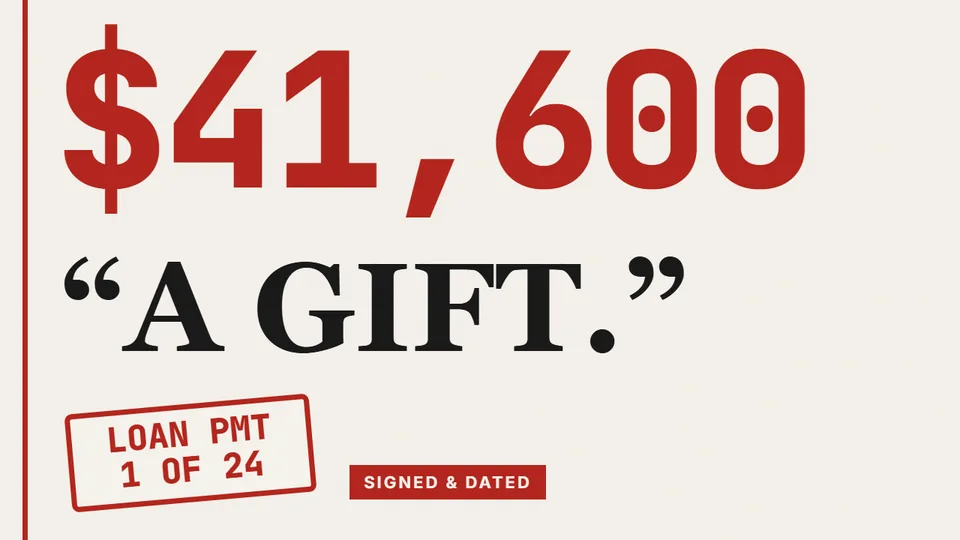
Lending money to family
Free. Last updated 9 October 2026
Money handed to a brother, a parent or a grown child is a loan in your head the moment it leaves your account. Whether it is a loan anywhere else — to the IRS, to a court, to the person who received it six years later — depends on things you can show, and almost all of them are cheapest to create on the day the money moves.
A loan is what you can prove, not what you meant
The IRS puts the test in one sentence in Publication 550: you must show that at the time of the transaction you intended to make a loan and not a gift. It then adds that money lent to a relative or friend with the understanding that it may not be repaid is a gift.
Notice where the test looks: at the moment the money moved, not at what either of you remembers later. Intention at the time is shown with things made at the time — a note, a rate, a schedule, and payments that actually followed it.
What goes on the note
One page is enough. What matters is that each of these is on it, because each is a question someone will ask later:
- Who and how much. Both full names, the principal, and the date the money was paid over.
- The interest rate. A number, with the month it was taken from. More on choosing it below.
- The schedule. How much each payment is, when the first one is due, and when the last one is due. The final date is the field most often left blank, and it is the one that tells a court when a missed payment became a breach.
- What happens if payments stop. Usually that the whole remaining balance becomes due.
- Both signatures and the date. Each of you keeps a copy.
Then pay and repay through a bank, not in cash, so that every payment leaves its own dated record. A memo line on a check that says which payment it is — 3 of 24 — is worth more than it looks: nobody numbers the installments on a present.
The rate comes from a table, and the date picks the row
The IRS publishes the Applicable Federal Rates every month as a revenue ruling. There are three of them, and which one applies depends on how long the loan runs (26 U.S.C. §1274(d)):
- Short-term — a term of three years or less.
- Mid-term — over three years, up to nine.
- Long-term — over nine years.
Take the rate from the table for the month the loan is made, from the row that matches its term, and write both the month and the rate on the note. A loan with no fixed term — repayable whenever you ask — is measured against the short-term rate, and that rate keeps moving from period to period, which is one more reason to give the loan a schedule.
What happens if you charge nothing
A loan between individuals at less than the federal rate is a below-market loan under 26 U.S.C. §7872. The tax code splits it into two transactions: a loan at the proper rate, and a gift of the interest you did not charge — which the code then treats as paid back to you as interest income.
Two thresholds decide how much of that actually bites, and pages on this subject usually mention only the first:
- $10,000 or less outstanding between the two of you: the rule does not apply at all — unless the money is used to buy or carry income-producing assets, such as equipment for a business. Then it applies from the first dollar.
- $100,000 or less: the interest income treated as coming back to you is capped at the borrower's net investment income for the year, and counted as zero if that income is $1,000 or less — unless avoiding tax is one of the principal purposes of the loan.
So for many family loans under $100,000, charging no interest costs little in income tax. That is not the same as costing nothing. A rate on the note is also evidence: interest is one of the plainest marks of a loan, and its absence is one of the plainest marks of a gift. That matters most in the situation nobody plans for, which is the next one.
If the payments stop
Two things are worth knowing before you decide how hard to push.
The clock. Every state limits how long you have to sue on a written contract, and the limits differ widely — three years in some states, ten or more in others. When it starts depends on the note and on the state: a missed payment or a final due date gives everyone a fixed point to count from, while a note with no due date leaves the starting point open to argument. In many states a part payment or a signed written acknowledgment of the debt can restart it. Look up your own state's rule rather than trusting a general figure, including this one.
The deduction. If the money is truly gone, a personal loan that has gone bad can be deducted as a short-term capital loss on Form 8949, subject to the usual limits on capital losses. The conditions are strict (Publication 550, Topic 453):
- It must have been a genuine debt — an enforceable obligation to repay a fixed or determinable sum — and you must have intended a loan at the time.
- It must be totally worthless. A partly worthless personal loan cannot be deducted.
- It is deducted in the year it becomes worthless, and you must show you took reasonable steps to collect. You do not have to go to court if you can show a judgment would be uncollectible.
- You attach a statement: what the debt was and when it was due, who owes it and your relationship to them, what you did to collect, and why you concluded it was worthless.
- If you missed the right year, an amended return for a bad debt can be filed within seven years from the date that year's return was due.
Read the fourth item twice. The statement asks what you did. Years of silence while a relative does not pay can contradict a perfectly good note — the document says loan, and your own conduct says gift.
Already lent, and nothing on paper?
The cheapest fix is not a lawyer and not a backdated note. It is a written acknowledgment from the person who owes you: one message, in their own words, that calls it a loan and says how much and since when. It is dated, it is theirs, and it is the kind of record the questions above are looking for. If you both still mean it as a loan, follow it with a note and a schedule from today forward.
If you would rather it be a gift
That is a legitimate choice, and it is better made on purpose. Say so in writing. A gift to one person above the annual exclusion — $19,000 for 2025 and for 2026 — requires a gift tax return, Form 709, though tax is rarely owed because it applies only once lifetime gifts pass the basic exclusion ($15,000,000 for 2026). Forgiving a loan later is also a gift, made on the day you forgive it.
Where to read the primary sources
- Applicable Federal Rates — the monthly revenue rulings, newest first.
- Publication 550 — chapter 4, Nonbusiness Bad Debts: genuine debt, loan or gift, when deductible, and the statement to attach.
- Topic 453, Bad debt deduction — the short version.
- 26 U.S.C. §7872 — below-market loans, including both thresholds above.
- What's new — Estate and gift tax — the annual exclusion by year.
What this page is not
It is not tax or legal advice. Whether a note is enforceable, and for how long, is a matter of your state's law, and the tax consequences depend on numbers we cannot see. What this page can do is tell you which records the questions turn on, so that you make them while they are still cheap.