Separating from a business partner
Free. Last updated 10 October 2026
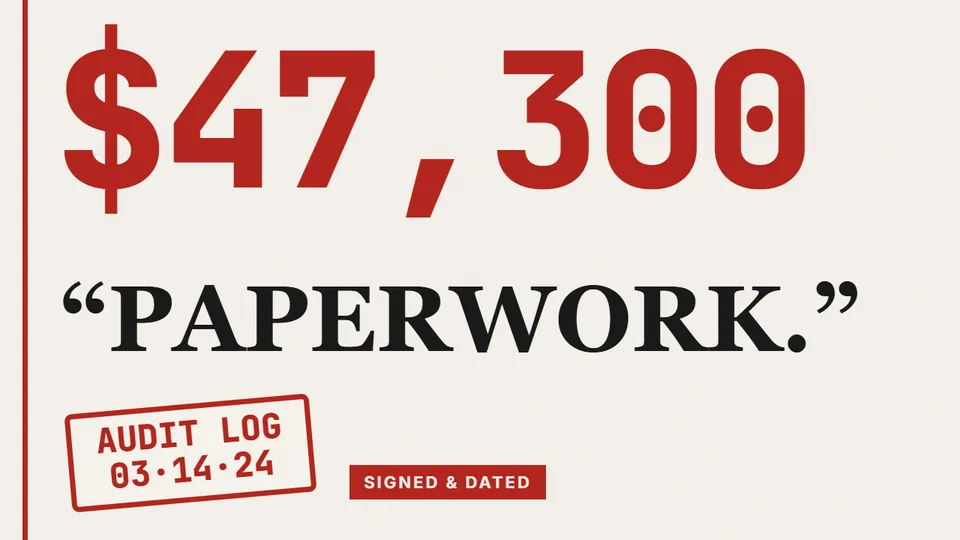
You find payments you cannot explain, to a vendor you have never heard of, approved by the person you have run the business with for years. The instinct is to act fast — move the money, lock the account, start fresh somewhere else. What usually decides how this ends is not how fast you moved, but the order you did things in, whether each step was one you were entitled to take, and whether the record of it was made by someone other than you. The specifics below are Ohio's, the state the episode's story is set in; the duties and fees are set state by state.
A date proves the order
The same act reads two ways depending on when it happened. A new entity formed, a new account opened, a contract renewed in the ordinary course before any dispute is administration. The same steps taken the week after you confront a partner read as a reaction — or as moving assets out of reach.
Only dates can tell those two stories apart, and only dates you did not write are hard to argue with: a state filing record, a bank's timestamp, a customer's signature on a renewal, an email from a third party's server. Everything you write about yourself afterward is your side of it.
First: the duties you still owe
This is the part most advice leaves out, and it can turn self-protection into the very claim the other side makes against you. Until the business is divided, you are still a co-owner, with duties to it and to your partner.
- In an Ohio LLC run by its members (no designated managers), each member's duty of loyalty includes accounting to the company for any benefit derived from the appropriation of a company opportunity, and refraining from dealing with the company on behalf of a party whose interest is adverse to it (Ohio Revised Code 1706.31). A written operating agreement can expand, restrict or eliminate those duties, but cannot eliminate the implied covenant of good faith and fair dealing (1706.08).
- In an Ohio general partnership the list is longer: a partner must also refrain from competing with the partnership in its business before it is dissolved (1776.44), and the partnership agreement cannot eliminate the duty of loyalty, though it may name specific activities that do not violate it (1776.03).
In practice: moving the shared company's customers, contracts or cash into a business that only you own can be exactly what a court is later asked to call a breach — even if every customer signs willingly. The law also says a member does not breach a duty merely because the conduct serves the member's own interest, and lets all members approve a specific act after full disclosure. Where the line falls depends on your agreement and your facts. Read your operating or partnership agreement, and talk to a business lawyer before you move anything that belongs to the shared company.
Second: get to the records you are entitled to
An Ohio LLC member may, on reasonable notice, inspect and copy during business hours any record the company keeps, to the extent it is material to the member's rights and duties (1706.33). That includes the books you may already use every week.
- Pull the vendor history. Every payment to the payee you cannot explain, in one column, with dates. Payments that look small one at a time are often only alarming in a row.
- Check the audit trail. If your accounting software keeps a change log, export it while you have access. It records who changed which entry and when — including entries edited after the payment cleared — and nobody's memory competes with it.
- Keep the supporting documents. The IRS lists them in Publication 583: sales slips, paid bills, invoices, receipts, deposit slips and canceled checks. An invoice with a total and no line items is worth a copy and a question.
Third: if you form a new entity, form it first
Forming a company moves no money. An empty entity with a filing date is a fact; what gets examined later is what went into it, when, and whose it was. In Ohio:
- Form 610, Articles of Organization for a Domestic Limited Liability Company, has a $99 filing fee.
- Expedited service costs extra: $100 for two business days, $200 for one, and $300 for four hours — that last option requires in-person delivery and applies only to documents received by 1 p.m.
- The EIN comes from the IRS, free, and is issued immediately online if approved. The IRS's own instruction is to form the LLC with the Secretary of State before applying. It also warns against websites that charge for an EIN; you never have to pay for one.
Whether a new entity is the right step at all — a new company, a subsidiary of the shared one, or a negotiated split — is the question to put to the lawyer, given the duties above.
Fourth: separate the money, and check the controls are real
The IRS's advice for any business is a business checking account kept separate from personal money, reconciled every month. When a partner is involved, two more points matter:
- A two-signature rule is only as good as the bank's agreement to enforce it. Some banks say plainly that they will not. Chase's current deposit account agreement, for example, states that it is not required to comply with any multiple-signature requirement on personal or business accounts, and that such a requirement is "for your internal control purposes only." Ask your bank, in writing, whether it will refuse a check, a transfer or an online payment that has only one approval — the answer can differ for each.
- Taking shared money out to protect it is the same act you are worried about. Get advice before moving funds that belong to the shared company, however justified it feels.
Fifth: let other people's dates do the work
The records that hold up are the ones somebody else made, in the ordinary course of their own business, before there was a dispute:
- the state's filing record for any entity, with its date;
- bank timestamps on every transfer, in and out;
- emails from lenders, sureties, insurers or customers, dated by their servers;
- a customer's signature and date on a contract renewal;
- a notary's certificate recording the day a signature was acknowledged.
Never backdate anything. A document dated before the event it is accused of answering is powerful precisely because nobody can fake that order without it showing — and a backdated one turns a strong position into a weak one.
The order, in short
- Read the operating or partnership agreement.
- Preserve the records you are entitled to, including any audit trail.
- Talk to a business lawyer before moving any shared money, customer or contract.
- If a new entity is right, form it before any money moves, and keep the stamped filing.
- Open a separate account, with controls the bank has confirmed in writing.
- Keep collecting other people's dates. Do not create your own after the fact.
Where to read the primary sources
- Ohio Revised Code 1706.31 — duties of an LLC member, including loyalty and company opportunities.
- 1706.08 — what an operating agreement may and may not change.
- 1706.33 — a member's right to inspect company records.
- 1776.44 — a partner's duties, including not competing before dissolution.
- Ohio Secretary of State: filing forms and fee schedule — Form 610 and the expedite options.
- IRS: Get an employer identification number — free, online, and after the state filing.
- IRS Publication 583 — separate business accounts, supporting documents, monthly reconciliation.
- Chase Deposit Account Agreement — section 11, multiple signatures (PDF). One bank's contract, cited as an example of what to ask yours.
What this page is not
It is not legal or tax advice, and a dispute between co-owners is exactly the situation where general information runs out fastest: the answer turns on your agreement, your state's law and facts no web page can see. What this page can do is show you which steps are judged by their order, and which records will be read later, so that you get both right while it is still early.